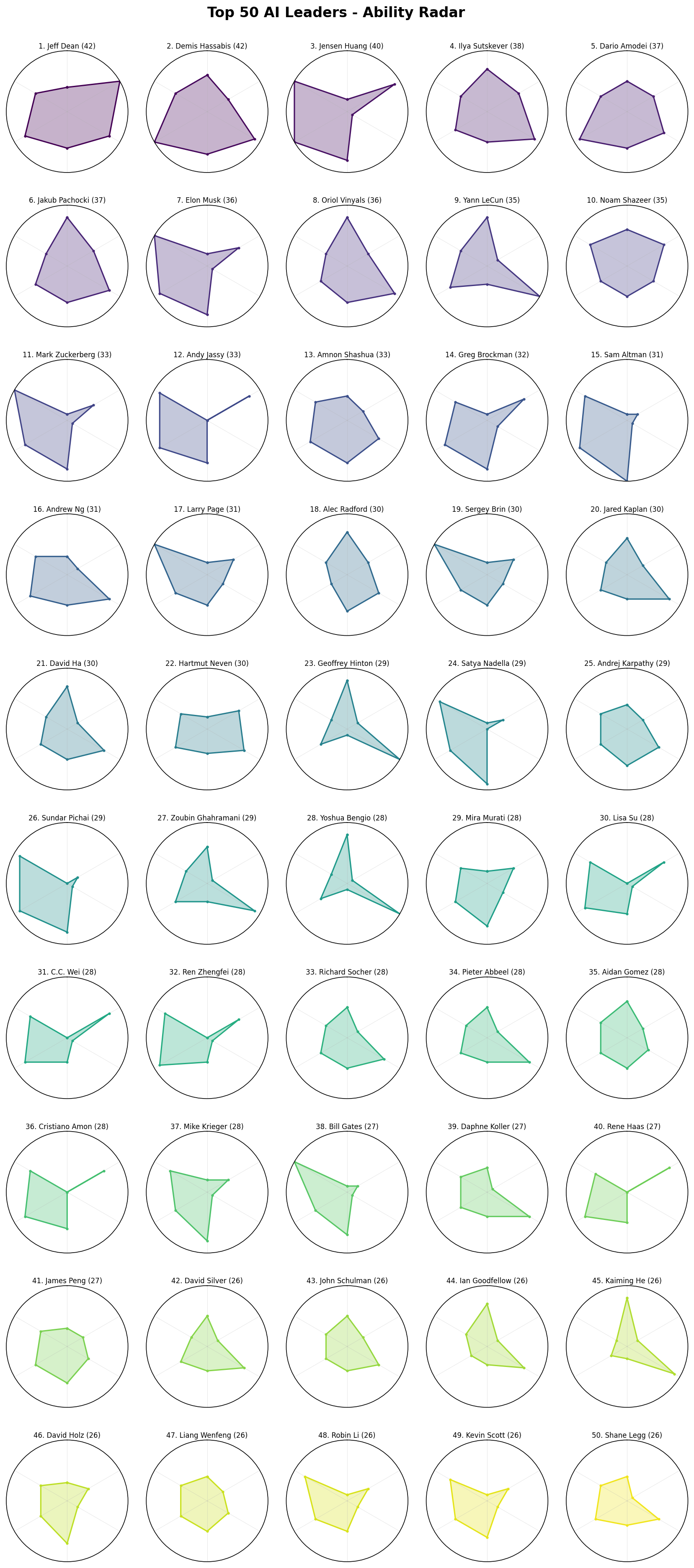
Here is a visualization of how Gemini 3 perceives the abilities of top AI leaders across different dimensions. I intentionally made use of the full scale of 1-10 to avoid clustering around the median.
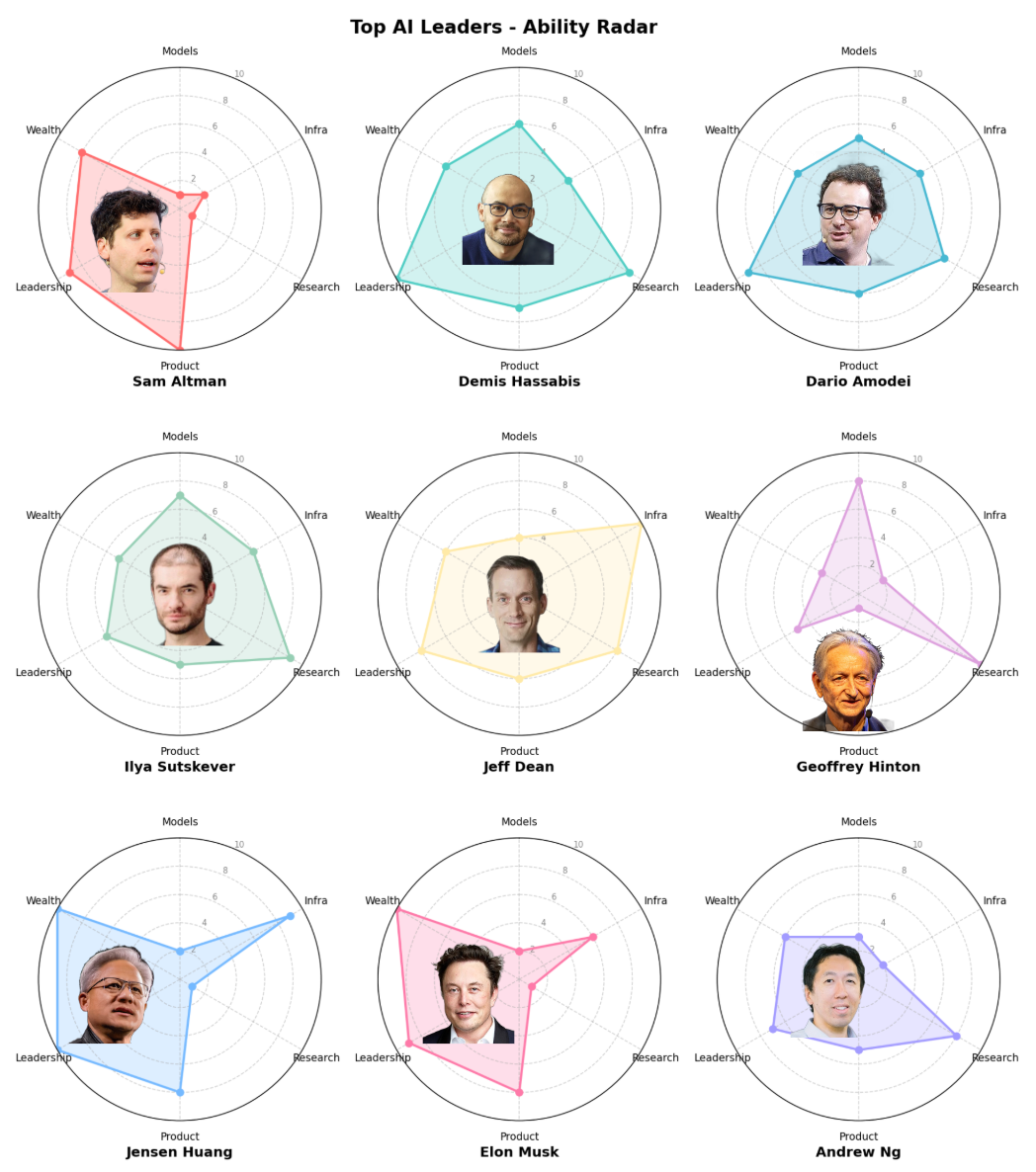
Prompt Used
Below is the prompt used to generate this data, which is also generated by Gemini 3. I chose the 6 dimensions after thinking about the dimensions for a while.
AI Leader Influence Scoring Standards (0-10)
Please score each AI figure on a scale of 0-10 based on the following 6 dimensions. Scoring Principle: Please make full use of the 1-10 range, avoiding clustering around the median.
1. Models – Original Architecture/Paradigm
Definition: Original contributions to AI model architecture and algorithmic paradigms. Includes proposing new architectures, core algorithmic innovations, and breakthroughs in training methods.
Reference Points:
- 10: Ashish Vaswani – First author of the Transformer architecture, revolutionized the AI paradigm.
- 7: Alec Radford – Primary architect of GPT series/CLIP, established the paradigm for large-scale Generative Pre-training application.
- 4: Andrej Karpathy – Promoter of early RNN/LSTM application paradigms, excellent educator and practitioner, but core originality is slightly below architecture proposers.
- 1: Sam Altman – Business leader, no contribution to model architecture.
2. Infra – Systems & Distributed Engineering
Definition: Contributions to AI infrastructure, training systems, distributed computing, and hardware optimization at the engineering level.
Reference Points:
- 10: Jeff Dean – Chief Architect of Google’s large-scale distributed systems (MapReduce/BigTable/TensorFlow).
- 7: Greg Brockman – Engineering setup of OpenAI’s massive training clusters and engineering implementation of Scaling Laws.
- 4: Alexandr Wang – Founder of Scale AI, built core data labeling and processing infrastructure, but not low-level systems.
- 1: Nick Bostrom – Philosopher, no engineering background.
3. Research Impact – Academic Influence
Definition: Influence in academia, including paper citations, pioneering research, talent cultivation, and defining research directions.
Reference Points:
- 10: Geoffrey Hinton – Godfather of Deep Learning, Nobel/Turing Prize winner, academic titan.
- 7: David Silver – Chief Scientist at DeepMind, core author of AlphaGo/AlphaZero, absolute authority in Reinforcement Learning.
- 4: Timnit Gebru – Well-known researcher in AI Ethics and Bias, influential in specific areas but limited breadth.
- 1: Jensen Huang – Industry leader, no academic research output.
4. Product / Practicality – Product & Real-world Application
Definition: Ability to translate AI technology into actual products, services, or applications; user scale and actual business impact of products.
Reference Points:
- 10: Sam Altman – Pushed ChatGPT to the world, defined the product form and business model of AIGC.
- 7: Mira Murati / David Holz – Mira led the engineering execution and release of ChatGPT/DALL-E; David built Midjourney, a highly profitable vertical product.
- 4: Clement Delangue – CEO of Hugging Face, built a successful developer community product, but C-side penetration is lower than ChatGPT.
- 1: Yoshua Bengio – Focused on fundamental research, rarely has direct consumer-facing products.
5. Leadership / Judgment – Leadership & Strategic Judgment
Definition: Organizational leadership, strategic judgment, team building, and quality of key decisions.
Reference Points:
- 10: Jensen Huang – Led Nvidia through 30-year cycles, accurately bet on AI hardware, helmsman of a trillion-dollar empire.
- 7: Satya Nadella – CEO of Microsoft, decisively invested in OpenAI and reshaped Microsoft’s strategic judgment.
- 4: Arthur Mensch – CEO of Mistral AI, leader of Europe’s strongest AI startup, showed good early leadership.
- 1: Ashish Vaswani – Top researcher, but the turbulence in founding Adept/Essential shows leadership remains to be proven.
6. Wealth / Resources – Wealth & Resource Mobilization
Definition: Personal wealth, mobilizable capital, influence on AI investment, resource integration ability.
Reference Points:
- 10: Elon Musk – World’s richest person, owns multi-dimensional top resources like xAI, Tesla clusters, Twitter data.
- 7: Eric Schmidt – Former Google CEO, top tech billionaire and core connector in politics and business.
- 4: Alexandr Wang – One of the youngest self-made billionaires, abundant resources but less than giants.
- 1: Typical University Professor – Has academic resources but lacks large-scale capital mobilization ability.
Output Format
Please output in table format:
| Name | Models | Infra | Research | Product | Leadership | Wealth | Total | Brief Comment (One sentence) |
|---|---|---|---|---|---|---|---|---|
| Example | 0 | 0 | 0 | 0 | 0 | 0 | 0 | Comment… |